The Real Battle of Troy: Separating Legend from 2025 Archaeological Facts.


The Battle of Troy (Legend)
A War That Began With a Promise and Ended a Civilization.
The ships arrived at dawn, From the walls of Troy, watchers saw dark shapes spreading across the sea—hundreds of vessels cutting through the mist, their sails heavy with wind and intention. No one on those walls yet knew that this moment would begin a war remembered for more than three thousand years.
This was Troy, a wealthy city overlooking the narrow passage between the Aegean and the Black Sea. Its towers guarded trade routes, its storehouses overflowed, and its kings believed its walls could never fall.
They were wrong.
The Spark That Lit the Fire
The story begins not with armies, but with a journey.
Paris, prince of Troy, traveled to Sparta as a guest. He left with Helen, the queen of Sparta, carried away across the sea. Whether she fled willingly or was taken by force was never agreed upon—but it did not matter.
In the ancient world, this was more than an insult. It was a violation of honor.
Menelaus, Helen’s husband, called upon the kings of Greece, men bound by old oaths and promises. One by one they answered—Agamemnon, Odysseus, Ajax, Nestor, and Achilles, the greatest warrior of his age.
Together, they sailed east.
Ten Years Before the Walls
The war did not end quickly.
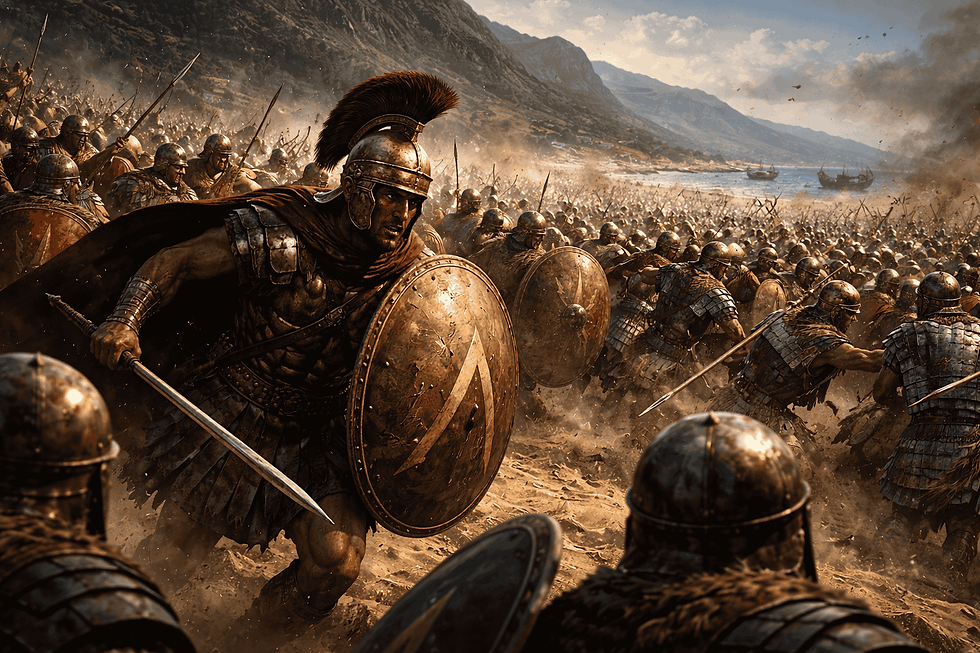
Troy did not fall in a single battle or heroic charge. Instead, the Greeks camped on the shore for nearly ten years, launching raids, fighting skirmishes, and challenging Trojan champions beneath the Scaean Gate.
Heroes rose and fell.
Achilles cut through enemies like a storm, yet withdrew when pride wounded him. Hector, prince of Troy, stood as the city’s shield, returning each night to his family knowing he might not see the next dawn.
The fighting was brutal, personal, and unforgiving. This was warfare without mercy—spears splintering shields, chariots thundering across dust-filled plains, and bodies left beneath the sun.
The Day Troy Wept
The war turned when Hector faced Achilles.
Before the walls of Troy, Hector fell. His death was not just the loss of a warrior—it was the breaking of Troy’s spirit. From that moment on, the city fought on borrowed time.
Yet even then, Troy did not surrender.
The Greeks could not breach the walls. Force alone was not enough.
So they chose deception.
The Horse at the Gate
One morning, the Trojans awoke to silence.
The Greek camp was empty. Ships were gone. In their place stood a massive wooden horse, towering above the beach. Some called it a gift. Others warned it was a trick.
Against warnings, the horse was dragged inside the city.
That night, while Troy celebrated, Greek warriors emerged from its hollow belly. Gates were opened. The fleet returned under cover of darkness.
By dawn, Troy was burning.
The Fall of a City
The streets filled with fire and screams. Palaces collapsed. Temples were desecrated. Kings were slain where they stood. Women and children were taken as captives.
Troy, once unassailable, was reduced to ash.
Those who survived fled—among them Aeneas, who would carry Troy’s memory far from its ruins.
Archaeological Facts
For centuries, the Trojan War was considered a beautiful myth—a story of gods, heroes, and a giant wooden horse. But as of 2025, the dirt of northwestern Turkey is telling a much more grounded, violent, and fascinating story.
Here is the simple breakdown of what we once thought was legend versus what 2025 archaeology has actually proven.
The Legend: A massive, wealthy kingdom ruled by King Priam, with "impenetrable" walls.
The 2025 Reality: Excavations at the site of Hisarlik have confirmed that Troy was a major trade hub near the Dardanelles. In 2025, archaeologists identified layers dating to 1200 BCE (Troy 6 and 7) that match the era of the war. These layers show a sophisticated city with a sprawling "lower city" that could hold thousands of people.
The War: Not 10 Years, but Definitely Violent
The Legend: A 10-year siege sparked by the abduction of Helen, ending in the total destruction of the city.
The 2025 Reality: While we can't prove Helen existed, we have found clear evidence of a violent sack. In July 2025, Professor Rustem Aslan’s team discovered a massive cache of 3,500-year-old sling stones concentrated just outside the palace walls.
New Evidence: Along with these stones, researchers found arrowheads and hastily buried human skeletons within charred building remains. These findings suggest a sudden, catastrophic fall rather than a slow decline.
The Trojan Horse: Fact or Metaphor?
The Legend: A hollow wooden horse that smuggled Greek soldiers inside the city gates.
The 2025 Reality: No physical "horse" has ever been found. Most 2025 scholars believe the "horse" was a metaphor for one of two things:
A Siege Engine: A wooden battering ram or tower covered in damp horse-hides to prevent it from being set on fire.
An Earthquake: Archaeologists found that Troy VI was heavily damaged by an earthquake. Since the god of earthquakes, Poseidon, was also the god of horses, the "Trojan Horse" might have been a poetic way to describe the walls collapsing due to nature.
Soldiers at Rest: The 2025 "Gaming" Discovery
One of the most humanizing finds of the 2025 season was a metacarpal bone (a hand bone) that appears to have been used as a gaming die. Found near the defense layers, it gives us a glimpse into the lives of soldiers who spent their time playing games while waiting for the next assault.
Summary: What We Know Now
Feature | Legend | 2025 Archaeological Fact |
Location | Mythical Troy | Hisarlik, Turkey |
Cause | Helen of Troy | Likely trade and territory disputes |
The Fall | Sneaky Horse | Violent assault (fire, sling stones, arrows) |
The End | Total Annihilation | City was violently sacked, then eventually rebuilt |
The Bottom Line: While the Horse and 10-year duels might stay in the history books as poetry, the Battle of Troy was a very real, very brutal event that marked the end of the Bronze Age in the Mediterranean.


Comments