The Battle of Cannae: Hannibal’s Brilliant Battle Plan Simply Explained


The Battle of Cannae — Hannibal’s Perfect Trap (216 BC)
In 216 BC, on the dusty plains of southern Italy, two ancient superpowers collided in one of history’s most decisive and shocking battles. The Roman Republic — proud, disciplined, and relentless — faced Hannibal Barca, the brilliant Carthaginian general who had already crossed the Alps and stunned Rome with earlier victories.
At Cannae, Hannibal turned a risky battlefield situation into a masterpiece of strategy that is still studied by modern armies today.
Quick Facts
Date: 2 August 216 BC
Location: Cannae, Apulia, Southern Italy
War: Second Punic War
Commanders: Hannibal Barca (Carthage) vs Roman consuls Paullus & Varro
Forces: Rome ~86,000 vs Carthage ~50,000
Outcome: Decisive Carthaginian victory
Legacy: One of the greatest tactical victories in military history
Background — Rome vs Carthage in the Second Punic War
The Second Punic War (218–201 BC) began as a struggle for control of the western Mediterranean — especially Spain and North Africa. Hannibal boldly invaded Italy, defeating the Romans at Trebia and Lake Trasimene.
Rome responded by raising a massive army to crush him once and for all.
Roman Consuls: Lucius Aemilius Paullus & Gaius Terentius Varro
Roman Army Size: ~80,000 infantry + 6,000 cavalry(one of the largest field armies Rome ever assembled)
Hannibal’s multicultural army included:
Carthaginians
Iberians (Spanish tribes)
Gauls
North African Numidian cavalry
He fielded around 40,000 infantry + 10,000 cavalry — vastly outnumbered.
The Battlefield — Open Plains Near Cannae
Hannibal chose ground that favored him:
Wide, flat fields
Ideal for cavalry maneuvers
Wind often blew dust toward the Romans
Rome relied on infantry strength. Hannibal knew if he could control the cavalry fight, the rest would follow.
The Tactics — A Deadly Trap
Hannibal arranged his army in a daring formation.
Center (weaker troops)
Spanish and Gallic infantry formed a forward-curving crescent.
Flanks (elite troops)
African heavy infantry waited on either side.
Cavalry
Numidian horsemen held the wings — especially strong on Hannibal’s left.
The Battle Unfolds
Phase 1 — Roman Confidence
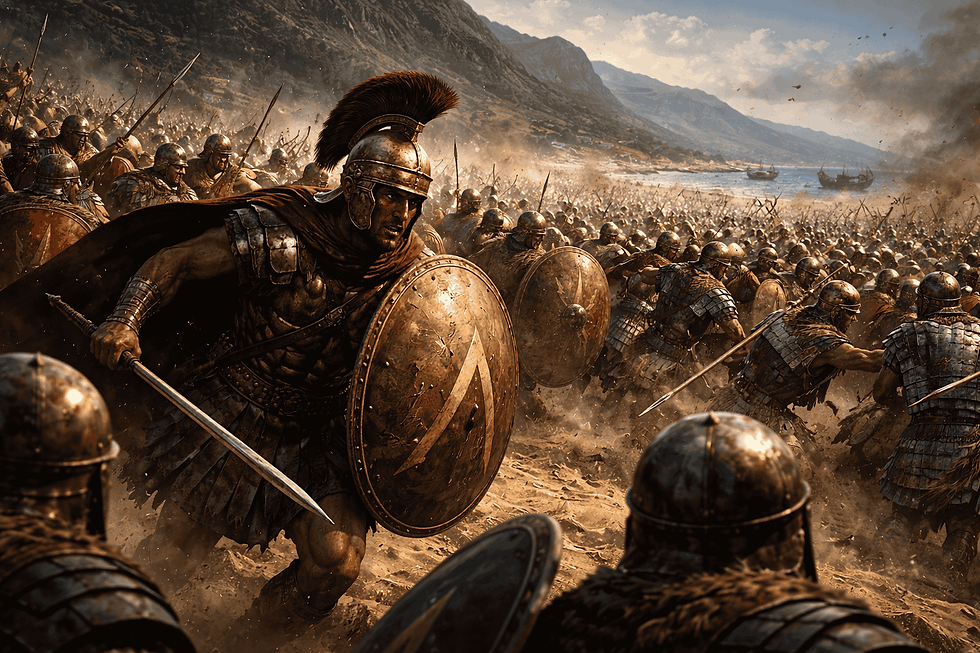
The Roman infantry advanced in a dense, heavy block — intending to smash straight through the Carthaginian center.
At first, it worked.
Hannibal’s center slowly bent backward under pressure — exactly as he intended.
Phase 2 — The Trap Springs
While the Roman infantry pushed forward:
Hannibal’s cavalry defeated the Roman horsemen on both wings
Numidian riders swept behind the Roman line
African infantry pivoted inward from the flanks
The Romans were now surrounded on all four sides.
They were trapped in a tightening ring of steel.
Phase 3 — Encirclement
The Roman formation collapsed into chaos. Crushed together and unable to maneuver, many soldiers couldn’t even raise weapons.
The slaughter lasted for hours.
An entire Roman army was destroyed.
Casualties — A Catastrophic Roman Defeat
Ancient sources give dramatic figures, but historians agree:
Up to 50,000–70,000 Romans were killed
Thousands more captured
Many senior officers died
Carthaginian losses were light in comparison.
Rome had never suffered anything like it.
Aftermath — Victory Without Final Triumph
Cannae was Hannibal’s greatest victory.
But…it did not end the war.
Rome refused to surrender.
Instead, they:
Avoided large pitched battles
Switched to guerrilla-style warfare under Fabius Maximus
Slowly wore Hannibal down
Attacked Carthaginian territories overseas
Years later, Rome defeated Carthage at Zama (202 BC) — ending the war.
Why Cannae Is Still Studied Today
Cannae is famous because Hannibal achieved what every general dreams of:
A double-envelopment maneuver encircling an enemy and destroying them completely.
Modern military academies — from West Point to Sandhurst — still analyze this battle for strategic insight.
It shows:
Superior tactics can defeat superior numbers
Mobility and timing can decide everything
Overconfidence can be fatal


Comments